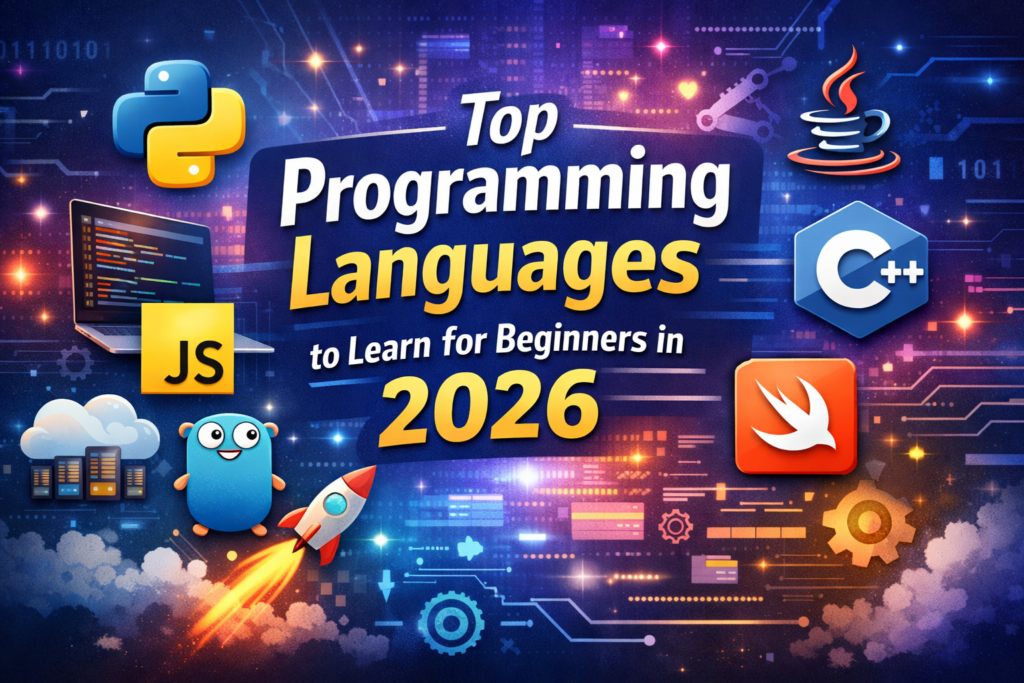
Entering the world of programming in 2026 can feel overwhelming, especially when you’re unsure which programming language to start with. With tech growing faster than ever—AI tools, automation, cloud computing, gaming engines—learning the right language can give beginners a massive advantage.
To help you choose, here’s a complete, natural, and beginner-friendly guide to the top programming languages to learn in 2026. Each section highlights why the language matters, where it’s used, and how it helps shape your coding journey.
1. Python — The Easiest and Most Beginner-Friendly Language
If you’re just starting out, Python is hands-down the best programming language for beginners in 2026. Its clean, readable syntax feels almost like writing English, making it perfect for absolute newcomers.
Why Python is perfect for beginners
- Super easy to learn and write
- Huge community and endless tutorials
- Extremely versatile
- Used everywhere from AI to web apps
Where Python is used
Python powers the biggest trends of 2026, including Artificial Intelligence, Machine Learning, Data Science, Automation, Cybersecurity, and Web Development. Popular libraries like NumPy, Pandas, TensorFlow, OpenCV, and Django make complicated work feel simple.
If you’re dreaming of entering the world of AI or data, Python is your best launchpad.
2. JavaScript — The King of Web Development
Every website you open uses JavaScript. If you want to build anything online, this is the language you simply cannot skip. In 2026, JavaScript remains one of the most in-demand programming languages.
Why JavaScript is beginner-friendly
- No complicated setup — it runs directly in your browser
- Perfect for beginners learning web development
- Enormous job opportunities in frontend & full-stack
- Supported by modern frameworks
Where JavaScript is used
From interactive websites to mobile apps, JavaScript powers it all. Tools like React, Next.js, Vue, and Node.js continue dominating the industry. Whether you’re targeting web development, mobile apps, or full-stack roles, JavaScript is a must-learn skill in 2026.
3. Java — Stable, Professional, and Highly Valuable
Even after decades, Java remains one of the most reliable programming languages for big companies. Banks, e-commerce giants, enterprises, and Android apps rely heavily on it.
Why Java is great for beginners
- Helps build strong coding fundamentals
- Extremely stable and future-proof
- Massive demand in enterprise tech
- Supports huge ecosystems like Spring Boot
Where Java shines
Java is widely used in Android development, cloud-based systems, financial apps, and enterprise software. If you’re aiming for long-term job security, Java is a smart and safe choice in 2026.
4. C++ — For Beginners Who Want Deep Computer Knowledge
If you want to understand how computers work at a deeper level, C++ is a powerful language to start with. While slightly more challenging, it builds strong foundations that make learning other languages easier later.
Why C++ is valuable
- Teaches memory management and low-level concepts
- Great for problem-solving and logic building
- Used where speed is critical
- Favored in competitive programming
Where C++ is used
In 2026, C++ is still dominant in game development, high-performance computing, robotics, operating systems, and embedded systems. If you’re passionate about gaming or hardware-level programming, C++ gives you an edge.
5. Go (Golang) — The Fastest-Growing Language for 2026
Go, created by Google, is exploding in popularity thanks to its speed and simplicity. It’s one of the best programming languages for beginners who want cloud or backend roles.
Why Go is beginner-friendly
- Very simple syntax (even simpler than Python for some learners)
- Incredibly fast performance
- Perfect for building scalable systems
- Used heavily in cloud and DevOps industries
Where Go is used
Go is everywhere in cloud computing, microservices, backend APIs, AI infrastructure, and DevOps tools. Companies like Uber, Google, and Dropbox swear by it, making it a strong career booster for 2026 and beyond.
6. Swift — The Best Language for iOS and Apple Ecosystem Beginners
Apple continues to dominate the mobile market, and Swift is the official language for iOS development. It is clean, modern, and surprisingly easy to learn.
Why Swift is ideal for beginners
- Simple, safe, and beginner-friendly
- Backed directly by Apple
- Huge opportunity in the iOS app market
Where Swift is used
Swift powers iPhone apps, iPad apps, macOS software, and even Apple Watch applications. If your dream is launching your own apps or landing a high-paying mobile developer job, Swift is an excellent choice.
Which Language Should Beginners Choose in 2026?
Here’s a quick beginner-friendly breakdown:
| Your Goal | Recommended Language |
|---|---|
| AI, Machine Learning, Automation | Python |
| Web Development & Full-Stack | JavaScript |
| Enterprise Jobs & Android Development | Java |
| System Programming or Gaming | C++ |
| Cloud, DevOps, Backend at Scale | Go (Golang) |
| iOS or macOS Apps | Swift |
If you’re unsure — start with Python or JavaScript.
They’re easy, powerful, and open doors to many career paths.
Final Thoughts
Learning any of these top programming languages for beginners in 2026 will set you on a strong path in the tech world. The trick is not to learn everything at once, but to pick one language, build real projects, and stay consistent.